
Most people think “doing their taxes” is a once-a-year task. That’s tax preparation, and it’s only half the picture.
Tax planning is the other half. It’s the part that saves you money. If you only prepare and never plan, you may pay more in taxes than you need to.
Here’s what each one really means. We’ll also cover how they work together, plus what to do before December 31 to strengthen your tax return.
What Is Tax Preparation?
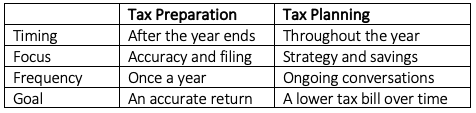
Tax preparation reports what already happened. Your accountant takes last year’s income and expenses. Then they file an accurate return with the IRS.
Tax preparation is:
- Backward-looking. It covers money that already changed hands.
- Deadline-driven. It’s built around the April filing date, or an extension.
- Focused on accuracy, not strategy.
- A once-a-year event for most taxpayers.
Think of tax preparation like a report card. It tells you how you did. By the time you see it, the year is already over. There’s nothing left to change.
What Is Tax Planning?
Tax planning looks forward. It means making smart money choices all year long, choices that can lower your tax bill before the year ends, not after.
Tax planning is:
- Proactive, not reactive.
- A year-round conversation, not a once-a-year appointment.
- Focused on strategy, like timing income or picking the right retirement account.
- Built around your goals, like growing a business or planning for retirement.
If tax preparation is the report card, tax planning is the study plan. It’s what you do ahead of time, so the report card turns out the way you want.
Key Differences at a Glance
Why the Difference Matters for Your Bottom Line
Once a tax year closes on December 31, most of your options close with it. A skilled preparer can find every deduction and credit you deserve. But they can’t undo choices you already made or change when you sold an investment. They can’t change how you paid yourself from your business or add money to a retirement account after the year ends.
That’s the real cost of skipping tax planning.
It’s not a mistake on the return. It’s a missed chance from months earlier that can’t be fixed now.
Business owners feel this the most. Choices about your business setup, your pay, equipment purchases, and retirement contributions all affect your taxes. Most of these choices need to happen before the year ends, not in March when your return gets prepared.
Signs You Need Both Working Together
You likely need a tax planning relationship, not just a once-a-year preparer, if:
- Your income changed a lot this year, from a raise, a business sale, or a new venture.
- You own a business or work for yourself.
- You’re near retirement or already take required minimum distributions (RMDs). These are withdrawals the IRS requires from most retirement accounts once you reach a certain age.
- You have investment gains or losses you haven’t reviewed with anyone.
- You’re often surprised by what you owe in April.
Your Year-End Tax Action Checklist
The window to change this year’s tax outcome closes on December 31. Before then, review the following with your advisor:
- Max out retirement contributions. For 2026, the 401(k) limit is $24,500. If you’re 50 or older, you can add an $8,000 catch-up ($11,250 if you’re 60 to 63). The IRA limit is $7,500, plus a $1,100 catch-up for those 50 and up.
- Take your RMD if you’re required to. Missing a required minimum distribution can trigger a steep IRS penalty. Confirm the deadline and amount with your advisor.
- Review your annual gifting. You can give up to $19,000 per person in 2026 without filing a gift tax return, a useful tool for estate planning.
- Check your investment gains and losses. Selling losing positions before year-end to offset gains, known as tax-loss harvesting, can lower your taxable income.
- Plan your charitable giving. Consider whether bunching a few years of donations into one year, or using a donor-advised fund, makes sense for you.
- Confirm your Q4 estimated tax payment. If you pay quarterly, the final 2026 payment is due January 15, 2027.
- Fund your HSA if you’re eligible. Health savings account contributions are tax-deductible and roll over year to year.
- Review year-end business decisions. Bonuses, equipment purchases, and owner pay can all shift your tax outcome. Most need to happen before December 31.
- Organize your records now. Start gathering documents in December, not March. That gives your tax planning team time to catch things a preparer alone might miss.
Download “The Ultimate Checklist for Tax-Ready Financials” to prepare for tax season efficiently.
Frequently Asked Questions
Do I need both a tax preparer and a tax planner?
Yes, though they’re often the same person or firm. Preparation makes sure your return is accurate and filed on time. Planning makes sure the numbers on that return are as good as they can be. When one firm does both, your strategy and your filing stay connected.
Can my accountant do tax planning and tax preparation together?
Many can, but not all do. Some accountants only prepare returns during tax season. They don’t offer year-round strategy talks. Ask your firm directly whether they offer ongoing tax planning, or only seasonal filing, so you know what you’re getting.
When should I start tax planning?
Tax planning works best as a year-round habit. But if you haven’t started, now is the best time. Even this quarter, you still have time to act on retirement contributions, charitable giving, and other year-end moves before December 31.
Is tax planning only worth it for wealthy people?
No. Business owners, self-employed people, and anyone with a changing income can benefit. Savings vary, but the strategy applies at almost every income level.
What happens if I only do tax preparation and skip planning?
You’ll still get an accurate, compliant return. What you may not get is the lowest tax bill available to you. Preparation reports the past. Planning shapes what comes next.
Get the Best Results
Tax preparation and tax planning solve two different problems. One reports what already happened. The other helps shape what happens next. The best results come from doing both together, with a team that knows your full picture, not just this year’s paperwork.
At Steel Ledger Advisors, we work with individuals and business owners on tax planning and preparation, wealth management, and financial and estate planning. Your tax return should never be the first place you learn about a missed opportunity.
Ready to talk through your situation with our team? Schedule a strategy session.