

An IRS notice isn’t always just a tax problem. It can also reveal weaknesses in your company’s financial reporting, recordkeeping, or internal controls.
Imagine opening an IRS letter that says your business owes thousands of dollars in additional taxes. Your first reaction might be to pay the amount, dispute it immediately, or hand it to your accounting department and hope for a quick resolution.
But for an established business, an IRS notice deserves more than a quick response. The issue could involve how your company reports revenue, tracks payroll taxes, documents expenses, or reconciles financial records.
And the wrong response could create unnecessary costs.
Here’s how to handle an IRS notice without making matters worse.
- Read the entire notice.
- Identify the tax issue and response deadline.
- Compare the IRS information with your company’s financial records.
For businesses with complex operations, the review should also consider whether the notice points to a larger accounting or reporting problem.
7 Costly IRS Notice Mistakes to Avoid
1. Treating the Notice as Routine Mail
An IRS notice can arrive at the worst possible time, when it’s easy for the letter to sit on someone’s desk.
But some notices involve strict deadlines that can affect your company’s ability to challenge proposed tax changes or exercise appeal rights.
A better approach is to:
- Establish a process for handling tax correspondence.
- Designate someone to receive IRS notices, record deadlines.
- Forward the complete documents to your CPA or tax advisor.
For growing businesses, this simple internal control can prevent a missed letter from becoming an expensive problem.
2. Assuming the IRS Has the Complete Financial Picture
The IRS compares information reported on tax returns with information received from other sources. But a difference doesn’t always mean your business underreported income or made an error.
Depending on the issue, the explanation could involve duplicate reporting, accounting classifications, or the timing of income recognition.
Consider reconciling the information in the notice with your filed tax return and supporting financial records before accepting a proposed adjustment.
3. Paying a Proposed Balance Without Evaluating the Impact
When an IRS notice shows a balance due, some business owners want to pay immediately and move on.
But that decision deserves a closer look.
First, the amount may be incorrect. Second, even when the balance is valid, paying it immediately could affect working capital needed for payroll, equipment, inventory, or other operating expenses.
For a company managing multiple projects or large customer receivables, an unexpected tax payment could create a cash flow problem.
If this happens, ask your tax advisor to verify the balance, including penalties and interest. If the amount is correct, evaluate payment options and deadlines alongside your company’s cash flow forecast.
Don’t assume you can delay payment without consequences. Interest and penalties may continue to accrue, and not every taxpayer qualifies for an installment agreement.
4. Responding Without the Right Documentation
A response that seems reasonable to management may not be enough to resolve an IRS question.
For example, if the IRS challenges a business deduction, your company may need more than an expense entry in its accounting software.
Identify exactly what the IRS is questioning. Gather relevant records, reconcile any differences, and submit the documentation requested through an approved response method.
Also, keep copies of everything that was sent and proof of submission.
5. Overlooking Payroll Tax Notices
Payroll tax notices deserve particular attention. Problems can arise from missed deposits, reporting differences, or errors involving payroll providers.
Also, outsourcing payroll doesn’t automatically eliminate the employer’s tax responsibilities.
In this case, review payroll tax notices promptly with your CPA and payroll team. Reconcile payroll reports, Forms 941, tax deposits, and other relevant records. If the notice involves unpaid employment taxes, seek professional guidance immediately.
6. Handling a Complex IRS Dispute Without Professional Guidance
Not every IRS letter requires extensive professional involvement. A simple payment posting question may be resolved by following the notice instructions.
However, a notice involving multiple tax years, substantial proposed adjustments, an examination, or collection activity can be more complicated.
The way your company responds may affect its financial position and available resolution options.
If that happens, involve an experienced CPA or other qualified tax professional when the issue involves significant tax exposure, complex transactions, or appeal rights.
An appropriately authorized professional can help evaluate the facts, prepare a response, and represent the business before the IRS when permitted.
7. Resolving the Notice Without Fixing the Underlying Problem
Suppose your company receives an IRS notice because information reported on its tax return doesn’t match its accounting records. Your CPA helps resolve the issue. The IRS closes the matter.
Problem solved? Not necessarily.
If the discrepancy resulted from inconsistent bookkeeping, poor communication between departments, or weak reconciliation procedures, the same problem could happen again.
Once the notice is resolved, ask what caused it.
- Were financial records reconciled regularly?
- Were payroll tax deposits and filings reviewed?
- Were transactions classified correctly?
- Did management have adequate documentation?
- Should accounting procedures or internal controls change?
An IRS notice may provide an opportunity to improve financial reporting and reduce future tax risks.
Which IRS Notices Require Immediate Attention?
Not every IRS notice carries the same level of urgency. However, business owners should recognize the difference between a routine information request and correspondence that could affect their financial or legal rights.
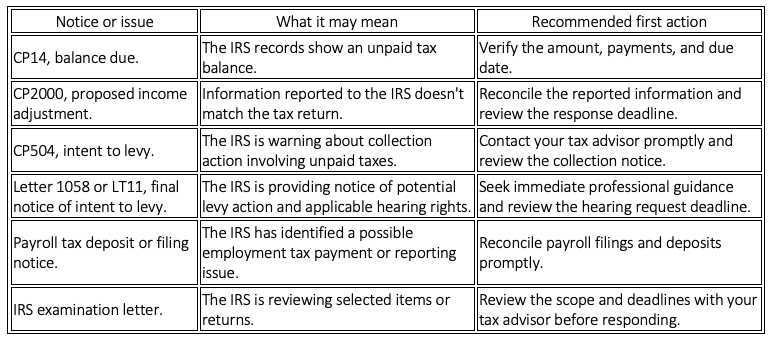
Notice types, deadlines, and taxpayer rights vary. IRS letter CP2000 generally concerns individual income tax information matching; businesses may receive other types of correspondence depending on their tax structure.
Frequently Asked Questions About IRS Notices
Does an IRS notice mean my business is being audited?
No. Many notices involve payment differences, missing information, or proposed adjustments. An IRS examination generally involves a separate process. Read the notice to determine the reason for the contact.
Can my business disagree with an IRS notice?
Yes. Depending on the notice, you may be able to challenge the proposed adjustment by providing records and an explanation. Follow the specific response instructions and deadlines.
What if my company cannot afford to pay the IRS?
Payment arrangements and other resolution options may be available depending on the tax liability and your company’s circumstances. We can help evaluate the options, costs, and potential cash flow effects.
Can the IRS hold a business owner personally responsible for unpaid payroll taxes?
In certain circumstances, yes. The IRS may assess a Trust Fund Recovery Penalty against individuals determined to be responsible for collecting, accounting for, or paying over trust fund taxes who willfully fail to do so. These situations require prompt professional attention.
How can a business reduce the risk of future IRS notices?
Accurate bookkeeping, timely tax filings, regular account reconciliations, organized supporting documents, and oversight of payroll tax deposits can help reduce avoidable errors.
Not every notice can be prevented, but better financial processes can make responding easier.
Received an IRS notice? Don’t guess about your next move.
For business owners, receiving an IRS letter can be frustrating. It takes time away from operations and may raise concerns about unexpected costs.
But the best response goes beyond answering the IRS. It involves understanding the issue, protecting your company’s financial interests, and determining whether your accounting and reporting processes need attention.
Steel Ledger Advisors helps businesses address tax concerns and make informed financial decisions. Our team can help you review the notice, evaluate your options, and determine an appropriate response.